DRAFT · Community review in progress. See something that looks wrong? Tell us.
Español English
Community Dashboard
Primary June 2, 2026
Updated May 20, 2026
Member Portal
This guide is free. If it helps you, help us keep it going.Support our work
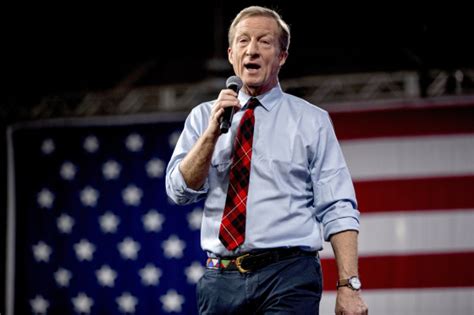
Tom Steyer
Campaign or press photo
Democrat · Top tier · polling average: 15.6%

Tom Steyer

Steyer is a billionaire hedge fund founder who turned into a climate activist, and he is running the largest self-funded gubernatorial campaign in California history, which is a fact worth sitting with before you read anything else about him. What he promises is single-payer healthcare, a campaign that takes no corporate PAC money, Prop 13 reform, and an audit and restructuring of the PG&E and SoCal Edison investor-owned utilities, the IOUs, so the question this profile asks is whether a man with that much money can be trusted to run on a platform that would tax people like him.

What the badges mean
Corporate moneyFunded by corporate PACs and big donors
Criminalize povertyBacks criminal penalties tied to homelessness
Defends immigrantsWants to limit or prosecute ICE in California
Grassroots-fundedRuns on small donors, no corporate or billionaire money
Healthcare for allBacks single-payer healthcare for everyone
Police powerComes from or is backed by police and sheriff power
Pro-ICEWants more state cooperation with ICE
Raise wagesBacks raising the minimum wage
Real estate moneyFunded by real estate and developers
Self-fundedBankrolled by their own personal fortune
Tax the wealthyBacks taxing extreme wealth
Tenant sideBacks rent control and tenant protections
Raised
$197.1M
Self-fund.
99.9%
IE for
$17K
IE against
$60.3M

He was born in 1957 in Manhattan, the son of Roy Steyer, who was a partner at Sullivan & Cromwell and a Nuremberg trial prosecutor, and Marnie, who taught remedial reading at the Brooklyn detention center, so he grew up around both corporate law and public service. He studied economics and political science at Yale and earned an MBA at Stanford, and he worked at Morgan Stanley from 1979 to 1982 before he ever started building his own fortune.

In 1986 he co-founded Farallon Capital Management, which grew to manage about $20 billion, and he ran it as senior managing partner for 26 years until he retired in 2012. While he was running it, his portfolio included positions in CoreCivic, the private prison company, from 2004 to 2006, as well as coal financing in Australia and Indonesia, and those investments are the part of his record that his opponents press hardest on.

After he left Farallon he founded NextGen America, which is the largest youth voter mobilization organization in the United States, and he ran for the Democratic presidential nomination in 2020. That same year Newsom appointed him chair of the Business and Jobs Recovery Task Force, and in 2021 he co-founded Galvanize Climate Solutions, so the years since 2012 have been spent on climate and on voter organizing rather than on hedge funds. He donated $12M to Proposition 50 in 2025, and he announced his run for governor in November 2025.

Steyer has never held elected office, which means there is no voting record to look at and there are no bills he has authored, and that is a real gap that voters deserve to weigh honestly.

Since there are no votes to evaluate, what we have instead are his decisions from positions of concentrated power, which means how he managed $20 billion at Farallon for 26 years, what causes he chose to fund, and what unelected positions he did hold, and those are the records this profile leans on.

YearsRoleWhat he did with that power
2020-2021Chair, CA Task Force (appointed by Newsom)Co-chaired with Ann O'Leary. Included Yellen, Tim Cook, Bob Iger. Final "Recovery for All" report in Nov 2020. Advisory only, no policy authority.
1986-2012Senior Managing Partner, Farallon Capital ManagementLead decision-maker at hedge fund with ~$20B in assets. His portfolio decisions (private prisons, coal) are his only substantive track record.
2012-presentFounder, NextGen America + Galvanize Climate SolutionsYouth mobilization at national scale. More than 1.5M registered. Largest individual donor in the U.S. in 2014 ($74M).

These are the topics Steyer covers in his campaign, and then the concrete promises he has made, because what matters is not just what a candidate talks about but what a governor could actually deliver, and for every promise there is a point where the office runs into a hard limit.

Areas he covers

Prosecute ICE / Immigration Single-payer (M4A) Audit and restructure IOUs (PG&E, SCE) Prop 13 reform + wealth tax Ban new oil and gas wells Housing and cost of living Education Green jobs Criminal justice Anti-corporate PAC AI regulation

The five most concrete promises

Promise · ICE and immigration
Prosecute ICE agents for illegal raids
He wants to use the governor's office to pursue federal officials, and he has named Stephen Miller and Kristi Noem specifically, for violations of California state law.
Steyer's defense: he argues this is the most concrete plan any candidate has put forward to protect us from Trump 2.0 federalism, and to his credit he acknowledges that the federal government, not California, is the one that controls ICE itself.
What a governor can actually do

A governor can direct the state Attorney General to bring civil enforcement for unlawful acts like assault or trespass when they are committed outside the scope of federal authority, and a governor can issue executive orders that restrict state cooperation, file lawsuits against DHS, and submit amicus briefs.

Hard limit

The hard limit is that federal agents acting within the scope of their official duties have federal officer immunity under the Supremacy Clause, a doctrine that comes from the 1890 In re Neagle case, and that immunity protects them from state prosecution, which is a limit that Steyer's own Substack post acknowledges rather than hides.

Impact for our community if delivered

If this were delivered it would mean fewer ICE raids in California schools, hospitals, workplaces, and courts, more protection for mixed-status families, and real limits on how much local police can cooperate with ICE, and for Southeast LA specifically it would mean protection for our mutual aid networks and safer routes to school.

Promise · Healthcare
State-level Medicare-for-All
He is promising universal single-payer-style coverage in California, and in December 2025 he said he was "wrong" to oppose Medicare-for-All back in his 2020 presidential campaign.
Steyer's defense: he explicitly owns the change rather than hiding it, he says that people evolve and that his daughters helped him reconsider, and his plan promises zero copays and zero premiums no matter a person's immigration status.
What a governor can actually do

A governor can sign single-payer legislation if the legislature passes it, can seek federal Section 1332 and Section 1115 waivers, and can deploy the authority of CDPH and DHCS, but the estimated cost is more than $300B a year, and opposition from the American Medical Association is a major political hurdle.

Hard limit

The hard limit is that it cannot be implemented unilaterally, because it requires both the legislature and federal cooperation, and although SB 770, the single-payer study, is already underway, actually implementing the policy would take multiple years.

Impact for our community if delivered

If this were delivered it would mean real universal coverage that eliminates copays, premiums, and the limited provider networks people are stuck inside now, and for immigrant families it would mean coverage regardless of immigration status, while for informal workers in SELA it would mean moving out of limited Medi-Cal and into the universal system, with dental, vision, and mental health coverage all held at the same level.

Promise · Climate and utilities
Cut electric bills 25% by breaking up IOU monopolies
He wants to audit and restructure the investor-owned utilities, meaning IOUs like PG&E and SoCal Edison, with the option of moving specific markets to public power, and alongside that he wants to introduce a public power option, stop all new oil and gas permits, and investigate the rate hikes that have been hitting families.
Steyer's defense: he argues that among the Democratic candidates his climate plan is the most detailed and the only one with specific numbers attached, and he points to his post-Farallon record, which includes $370M in Galvanize and the work of NextGen, as proof that his climate credibility is real.
What a governor can actually do

A governor can direct CPUC appointees, sign permit moratoriums through CalGEM, and push for legislation, and while blocking new permits is something that is reachable in the first year, restructuring the utilities is a multi-year effort that would be heavily litigated.

Hard limit

The hard limit is that breaking up the IOUs requires legislative action and probably a supermajority, the promised 25% rate cut still has no specifics behind it, and the IOUs have well-established investment relationships with the legislature that would not give way easily.

Impact for our community if delivered

If this were delivered it would mean genuinely lower electric bills for low-income families, which matters because SoCal Edison bills in SELA have gone up 60% in 5 years, and a competitive public option would push rates down, while for renters it would also mean protection against having their power shut off over unpaid bills.

Promise · Taxes and housing
Reform Prop 13 with a wealth tax
He wants to raise taxes on high-value commercial properties, and specifically he backs commercial Prop 13 split-roll reform and closing the Trump Tax Loophole at the corporate level. His support for the California Billionaire Tax Act ballot proposal is more qualified: he favors taxing the ultra-wealthy but has called the measure a temporary fix to a permanent, structural problem, the stance Fortune described as a "class traitor" platform.
Steyer's defense: he is a billionaire who is explicitly proposing to tax billionaires, which means he is putting his own wallet behind what he preaches, and that is not a small thing to say out loud.
What a governor can actually do

A governor can back and promote ballot initiatives, the way Prop 15 was promoted in 2020 before it lost by a narrow margin, can sign legislation that raises wealth taxes if the legislature passes it, and can set the budget priorities.

Hard limit

The hard limit is that changes to Prop 13 require a ballot initiative because Prop 13 is written into the state Constitution, and any wealth tax faces constant capital flight threats, which the opposition always raises, given that California already has the most progressive taxes in the country.

Impact for our community if delivered

If this were delivered it would mean significant revenue for affordable housing, public transit, and schools, since the Legislative Analyst estimated commercial Prop 13 reform could generate roughly $6.5B to $11.5B a year in the 2020 analysis of Prop 15, and for SELA that would translate into real funding for local schools and public transit.

Promise · Jobs and services
CCC-style guaranteed green jobs
He is proposing a state green jobs program inspired by the New Deal, along with public housing and universal childcare centers.
Steyer's defense: he is proposing a real jobs floor with decent wages, and he points out that NextGen already has experience mobilizing millions of young people around green jobs, so the organizing muscle for this exists.
What a governor can actually do

A governor can design and propose the budget, negotiate with the legislature, and use executive authority over existing departments like EDD, CDCR, and HCD, and infrastructure bonds can fund pieces of a program like this.

Hard limit

The hard limit is that real scale requires a multi-year budget, Prop 4 from 2014 imposes spending caps, and public housing at scale requires local zoning reform that the state does not directly control.

Impact for our community if delivered

If this were delivered it would mean direct jobs with decent wages for residents who do not have a college degree, and for SELA that would mean jobs in environmental cleanup, habitat restoration, and solar installation, while universal childcare would remove the main barrier that keeps mothers out of the labor force.

These are the six most serious attacks Steyer has faced in this campaign, and for each one we have summarized his defense, laid out the facts as we investigated them, walked through what it would mean for our community, and named the places where the defense actually has merit, because an honest profile has to do all four.

Attack 1 · Buying the election
Self-funded billionaire, not public servant
His opponents argue that because he has put $197M of his own money into this race, he has been able to bend the primary news cycle to his will.
Steyer's defense: he frames self-funding as freedom from corporate PAC influence, and he notes that he and Porter are the major Democratic candidates rejecting all corporate PAC money, so his argument is that wealth used in service of progressive ends is the opposite of corporate capture rather than another version of it.
The facts as we investigated them

Steyer has raised $197M, 99.9% of it self-funded, with zero corporate PAC money, and for context that figure is several times what a typical California gubernatorial campaign raises, so Steyer has already spent more in the primary alone than any gubernatorial candidate in California history, and his TV spend by itself is about $48M through May 1 according to AdImpact.

Community impact if the critique holds

If voters in SELA and other low-resource communities come to believe that any candidate with $197M can simply dominate the conversation, that can have a demobilizing effect, because it teaches people that money wins anyway, but on the other hand, if Steyer loses despite all that spending, it could signal that money is not actually decisive at this level.

Why the defense has merit (partial)

The "I reject corporate PAC" argument is verifiable and true, and the distinction between personal money used for progressive causes and corporate money used for capture is not nothing, but it still does not resolve the underlying democratic concern, which is that a single individual has the capacity to fund a $197M campaign with no consequences.

Attack 2 · Opportunistic M4A switch
Opposed Medicare-for-All in 2020, now campaigning on it
Porter framed it at the May 5 debate as a switch that came from opportunism rather than from conviction.
Steyer's defense: he publicly acknowledged in December 2025 that he was "wrong" in 2020, he says that people evolve, and he credits his daughters with helping him change his mind.
The facts as we investigated them

In 2020 Steyer ran ads opposing Bernie Sanders' Medicare-for-All, and in 2026 he is running on Medicare-for-All himself, so the switch is documented and public, and in December 2025 he made an explicit "I was wrong" statement, while his current platform now includes state Medicare-for-All as a central pillar.

Community impact if the critique holds

The risk is that if Steyer wins and then does not actually push Medicare-for-All, the communities that voted for the promise end up without the policy they were promised, which is the classic pattern of a campaign promise followed by a governing retreat, and this matters because universal healthcare is among the highest priorities in community surveys in SELA.

Why the defense has merit (partial)

The position change is documented and it happened before the campaign, in December 2025, rather than in response to primary pressure, and if it were pure opportunism the easier move would have been to deny the change, since saying "I was wrong" does carry political cost, but the historical pattern of billionaires allied with the insurance industry is real and it is fair to keep it in mind.

Attack 3 · CoreCivic and private prisons
Farallon invested in CoreCivic (private prisons) while Steyer ran it
Abolitionist activists have pointed to this record to question whether his turn toward criminal justice reform is genuine.
Steyer's defense: Farallon fully divested from CCA/CoreCivic in 2006, the position was only about 0.5% of peak assets under management, and he later backed AB 32 in 2019, which banned state contracts with private prisons.
The facts as we investigated them

Farallon held about $90M, or 2.27M shares, of CCA/CoreCivic from 2004 to early 2006, which means the position lasted about two years before they exited, and Steyer later backed AB 32, the Bonta bill from 2019 that banned state contracts with private prisons, and the Factually fact-check confirms this timeline.

Community impact if the critique holds

Immigrant families in SELA are more exposed to detention in private prisons, which are operated by CoreCivic and GEO Group under federal contracts, so if Steyer historically profited from that system it is a material problem for the immigrant community even with the later divestment, and the open question that voters have to sit with is whether the regret is complete or whether it is instrumental.

Why the defense has merit (partial)

The divestment is real and it happened 20 years ago, AB 32 is concrete legislation that Steyer supported, and the fact that California has zero state contracts with private prisons today is partly the result of that policy, and it is also true that Farallon's investments spanned hundreds of companies across many sectors, so CoreCivic was a small position within that.

Attack 4 · Coal financing
Farallon financed coal operations while Steyer ran as "climate leader"
The original reporting came from the New York Times in 2014, and it documented the Maules Creek mine in Australia, which Farallon helped finance with $455M during his tenure.
Steyer's defense: he says he fully divested from fossil fuels before he left Farallon, he acknowledges that the investments existed rather than denying them, and he argues that his post-2012 climate track record, which includes NextGen, Galvanize, and $370M in climate transition, is the evidence of how far he has evolved.
The facts as we investigated them

Farallon financed coal operations in Indonesia and Australia during Steyer's tenure, including a $455M debt and equity stake in the Maules Creek mine acquisition, and the original reporting on this came from the 2014 New York Times as referenced by The Hill, and his defense that he divested before he left Farallon has been challenged by later reporting that showed some of those investments were still active in 2012.

Community impact if the critique holds

For communities in SELA that are exposed to industrial pollution and nearby refineries, like the Wilmington industrial corridor and the LA and Long Beach ports, the pattern of a billionaire who invested in the very thing he now criticizes has material consequences that are not just symbolic.

Why the defense has merit (partial)

NextGen, Galvanize, and the $370M in transition assets are tangible and verifiable, and the level of his investment after 2012 far exceeds the financial damage from before 2012, so if the question is whether he is a climate ally now, the answer is yes, but if the question is whether he has made restitution to the communities harmed by his past investments, the answer is not clear.

Attack 5 · No elected experience
Has never held elected office
Becerra and Villaraigosa have used this point in debates to argue that Steyer lacks the operational experience it takes to govern California.
Steyer's defense: he argues that his executive experience at Farallon, where he managed $20B in assets, along with NextGen, Galvanize, and the Newsom Task Force, is comparable to elected experience or better, and he points to other governors who came in without prior legislative experience, like Schwarzenegger and Reagan.
The facts as we investigated them

He has held no elected office, authored zero bills, and cast zero votes, and his executive roles are Farallon from 1986 to 2012, NextGen from 2012 to the present, the CA Task Force from 2020 to 2021, and Galvanize from 2021 to the present, while his 2020 presidential campaign withdrew after South Carolina.

Community impact if the critique holds

A governor without legislative experience can face a significant learning curve in their first year, and that comes at a moment when California needs fast action on climate, housing, and immigration, so without pre-existing relationships with legislative leaders, the first budget negotiations can be rough.

Why the defense has merit (partial)

Schwarzenegger and Reagan are real precedents of governors who came in without prior elected experience, and Newsom had been SF mayor rather than a legislator, while experience operating organizations with more than $20B in assets under management is not trivial, but the counter-argument is that both Schwarzenegger and Reagan were significantly less effective in their first year than governors who came in with legislative experience.

Attack 6 · Paid influencers
Paid social media creators to post about him, some without disclosing it
His campaign has paid online content creators to post favorable videos about him, and California's political-transparency regulator has opened an investigation because some of those posts did not disclose the payment.
Steyer's defense: the campaign says creators deserve to be paid for their work, that its contracts with the content firms required the creators to disclose the payments, and that it has met its legal obligations, and it has filed its own complaint accusing the Becerra campaign of doing the same thing.
The facts as we investigated them

Campaign finance filings from January through April 18 show Steyer's campaign paid more than $123,000 to at least eight social media influencers, and it is separately paying more than $870,000 to a digital firm, Group Project Digital, that recruits creators to post daily videos about him. The state Fair Political Practices Commission, the FPPC, opened an investigation into one video by creator Isaiah Washington, who was paid $10,000 and whose now-deleted version of the video carried no disclosure, after two creators who support Becerra filed a complaint. The state influencer-disclosure law being tested here was written with no fines attached, so even a finding against the campaign would carry no real penalty.

Community impact if the critique holds

Paid posts that are built to look like a friend's honest opinion can manufacture the appearance of grassroots support, and for voters in SELA and other communities who increasingly get their news from social media, that makes it harder to tell a real recommendation from an ad, which is exactly the harm the disclosure law was meant to prevent.

Why the defense has merit (partial)

Paying creators for their work is legal, the campaign's instruction to its content firms to require disclosures is written into the contracts, and paid influencers are now common across campaigns, since Mahan's campaign has also paid them and the Becerra campaign is facing its own scrutiny, but the open question is whether telling a contractor to require disclosure is enough when the campaign does not review the posts and several of them still went up with no disclosure at all.

This section lays out who funds Steyer, who spends independent money for or against him, who has formally endorsed him, and how the outside organizations that apply their own scorecards have rated him, so that the money and the backing can be read together.

The money coming in

SourceAmountNotes
Self-funding (Steyer personal)$196.85M99.9% of total raised
Individual donors$193K0.1% of total raised, including 149 gifts under $200.
Committee and PAC money$9KLess than 0.01% of total. No corporate PAC money.

External Independent Expenditures (IEs)

IE = Independent Expenditure: committees that spend for or against a candidate without legally coordinating with the campaign. Independent spending against Steyer totals $60.31M, nearly all of it from one committee, while independent spending in his favor totals $17K.

CommitteeDirectionAmountNotes
California Is Not for SaleAgainst$60.31MThe committee running the organized opposition to Steyer, across 33 separate filings
Courage California State PACFor$17KProgressive voter-guide spending

Formal endorsements

  • Unions: SEIU California, UDW/AFSCME, UNITE-HERE Local 11, California Teachers Association (CTA)
  • Progressive organizations: NextGen America (his own org), Our Revolution (national progressive group founded by Bernie Sanders), Courage California, Third Act California
  • Elected officials: 4 state Assembly members, 1 state senator
  • Doesn't have: DSA-LA endorsement, Knock LA, LA Forward, Indivisible CA-46

External scorecard ratings

OrganizationTypeRatingLink
Sierra Club CaliforniaEnvironmental endorsementFull endorsementview
Courage California / Progressive Voters GuideProgressive rating"More progressive than viable"view
California Environmental VotersEnvironmental endorsementEndorsed (dual endorsement with Porter)view
California Labor FederationLabor endorsementMulti-candidate endorsement (Steyer, Porter, Villaraigosa)view
ACLU CaliforniaConstitutional questionnairePartial responsesview
LA ForwardLocal voter guideNo endorsement, "too much concentrated capital"view
Knock LALeft voter guideNo endorsementview
DSA-LASocialist endorsementNo endorsementview
LAist Voter Game PlanNewsroom voter guide"Profile with reservations"view
Latino Community FoundationLatino questionnaireFull responsesview

Full list of the 49+ scorecards and voter guides we track on the scorecards page.

This guide is free. If it helps you, chip in to keep it that way.